May 30, 2019
Western Front, Vancouver B.C.
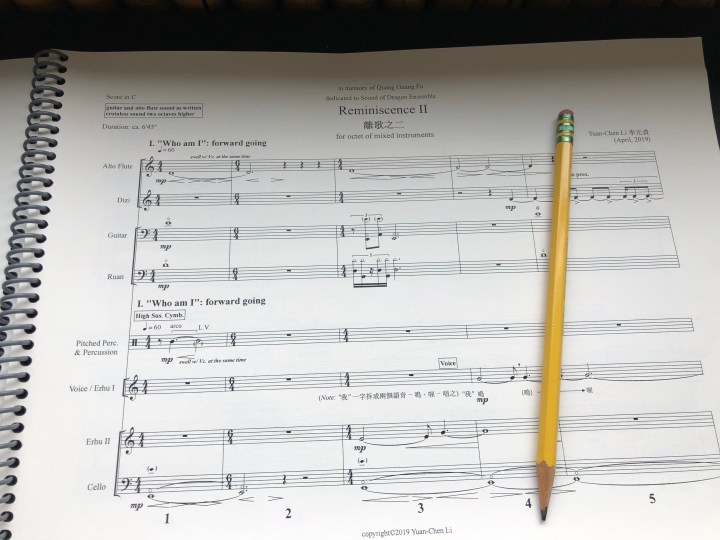
I am at Vancouver B.C. this week to rehearse my latest work Reminiscence II for mixed ensemble (octet), to be premiered by Sound of Dragon, director/producer Lan Tung (Sound of Dragon Society), conducted by Chih-Sheng Chen (Little Giant Ensemble). There are a few of questions accumulated since the ensemble started rehearsing two weeks ago. I wish to share some thoughts with the musicians as well as my friends/readers of my Facebook and blog.
- Why is the sound so literal? 為何如此寫實?
- Is this music just about playing the rhythm? 這音樂演的就只是節奏嗎?
- Motivation of the composition. 寫作的動機
Half of the instrumentations in this ensemble is in Chinese origin. In the literature of Chinese music, Realism is as common as the abstraction of Ying & Yang in art. Such as “十面埋伏” (Ambushed from Ten Sides, dated since 1818), a famous solo piece for Pipa, well depicts the sound of the martial scene. My imagination went back to the 20th century on the Second Sino-Japanese War and the civil war between the Communists and Republicans in China. In my Reminiscence II, sounds of missiles, machine guns, and rolling vehicles are depicted by glissando, knocking on the sound box of the instruments, and group tutti of seemingly irregular rhythms.
樂團的部分樂器是中國樂器。跟崇尚陰陽抽象的美術比起,傳統中樂文獻裡不乏寫實的例子。譬如,自明朝以來即有記載的琵琶獨奏名曲《十面埋伏》即相當程度地描繪了戰事的聲響。我以20世紀的抗日戰爭與國共內戰為背景,在我的新作《離歌之二》裡,描繪了現代戰場的聲音,例如飛彈、步槍、和大型戰車等,由滑音、敲打樂器共鳴箱、以及不規律的齊奏等等來表示。
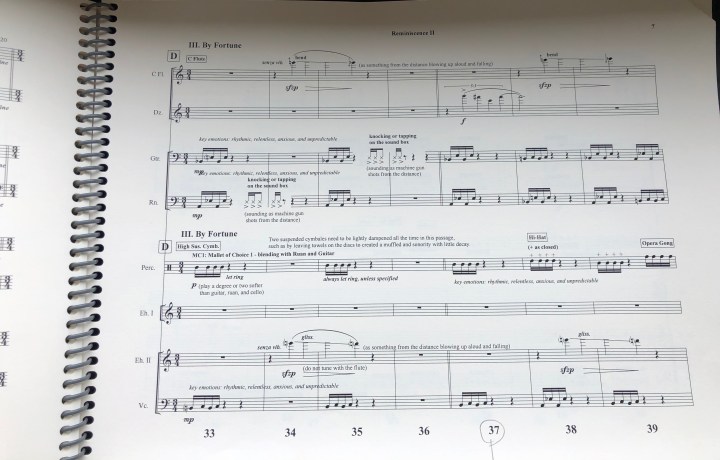
The section of the group irregular rhythms in Reminiscence II lasts roughly two minutes. It is a series of rough and quick sound made by Ruan, Guitar, Cello, and four different cymbals. They play four 16th notes in quick succession with an accent, and sometimes play a few of these figures in different dynamics in a roll. Despite the variety of these elements, the part looks like a lot of repetitions of the same notes. I wrote this rhythmic section, however, in 3/4 as the time signature, and underlaid subtle changes of meters in every six beats, hoping to make it somewhat “dance-like.” This design of rhythm intends to elicit the desire to dance, a sonorous manifestation of the drive to fight and kill – it is dangerous, but it is excitable.
在《離歌之二》裡,大約有兩分鐘左右的段落演著不規律的節奏。實際上是一系列快速音群,由大阮、吉他、大提琴、和四種不同的鑼與鈸所組成的。他們演的是四個16分音符,加上突強,於不同強度間轉換。除了這些變化的元素,分譜看來是一樣的音給一而再再而三的重複。然而,這段落是用三拍標的,並且潛藏了六拍群組,希望造成舞蹈的感覺。如此的設計是為了讓舞蹈的慾望來代表廝殺的彰顯 – 即便是危險的、但卻是興奮的。
I have questioned myself about what it means to write about someone’s memory of the human tragedy. About 13 million people perished in the civil war, and more than 17 million people died in the Sino-Japanese war. Not only that my grandmom survived through these battles in China, but also escaped with 1.2 million people to Taiwan in 1949. It is the magnitude of the life experience and pain that didn’t have the chance to be expressed until slipped through a little song sung in her late years while suffering from dementia. I compose Reminiscence II in hopes of presenting the song for her, and think of my grandmom that she would already have reunited with her family in the gardens of heaven, and never feel lonely and wandering again.
譜寫他人的故事,於我,我自問著,是什麼樣的意義?特別是,有關人生悲劇的故事。大約1300萬人死於國共內戰,1700萬人死於抗日戰爭。我祖母不僅自這些戰場僥倖,還與一百多萬人於1949年間逃到台灣。如此駭人的生活經驗和苦痛,卻一直沒有機會訴諸;而直到祖母晚年失智時才從她自編的小調裡透露出來。我寫著《離歌之二》,希望能把她的遭遇呈現出來,並希望她在天之靈已與她的親人團圓,而且不再感到孤獨與飄盪。
*More about the concert / 與音樂會相關的細節:
https://soundofdragon.com/sound-of-dragon-ensemble-melody-of-china/
** Thank RACC (Regional Arts & Culture Council) of Oregon and many granters for supporting the performance.
Composer Yuan-Chen Li was born in Tainan Taipei. She earned B.M.A. and F.M.A. from National Taipei University of the Arts, Artist Diploma from Yale School of Music, and Ph.D. in music from the University of Chicago. She is the recipient of the Chang-Hui Hsu Memorial Prize of Asian Composers League, Arts and Literature Awards from the Ministry of Education, and awarded the artist residency at Paris Cité Internationale des Arts and New York Omi International Arts Center, and the Best Art Music from Golden Melody Awards. Currently Li lives in Portland, Oregon in the United States where she composes, performs, and teaches. For more info, please visit her website at yuanchenli.wordpress.com
作者/李元貞為台灣台南人,國立臺北藝術大學音樂學士、碩士;耶魯大學音樂學院藝術文憑;芝加哥大學人文學院音樂博士。2003年亞洲作曲家聯盟許常惠獎得主、2006年教育部文藝獎得主、法國西提藝術駐村與紐約哈德遜 Omi 藝術村作曲家、金曲獎最佳藝術音樂專輯得主。目前旅居美國奧勒岡州波特蘭市,從事獨立音樂創作、表演、與教學。更多訊息見網頁 yuanchenli.wordpress.com
 Yuan-Chen Li ‧ 李元貞